My Arabic Music Liner Notes
Listening to music in your target language will not magically make you fluent — as certain people trying to sell you a course may claim — but it is one of the easiest ways to give your ear repeated, emotionally sticky contact with the language. Songs expose you to the sounds, rhythm, intonation, phrase boundaries, and recurring chunks of speech in a form you are actually willing to hear again and again.
That matters: research on song-based language learning has found benefits for pronunciation and vocabulary learning, including a 2023 study in Languages showing that singing songs supported second-language pronunciation and vocabulary acquisition, and a study in Studies in Second Language Acquisition finding that repeated listening to songs can contribute to incidental vocabulary learning. A broader systematic review from Oxford researchers found that songs are widely used in foreign-language classrooms and that the research base includes measured outcomes for vocabulary, grammar, speaking, listening, reading, and writing.
None of this means that music replaces comprehensible input, conversation, grammar study, or deliberate practice. It means that music is a powerful supplement: it lowers friction, increases repetition, and helps the language start sounding less like noise and more like a living human pattern.
This is also why a song lyric can sometimes beat a flashcard. A flashcard can tell you that غيرة / ghīra means jealousy, that حتى / ḥatta means “even,” and that شمس / shems means sun. Useful, yes. But compare that to hearing Ÿuma sing something like نغير عليك حتى من الشمس — “I get jealous over you, even from the sun.” That line has melody, feeling, repetition, absurdity, and romance wrapped around the vocabulary. The words are no longer isolated labels. They are part of a charged emotional scene.
That is the advantage of music as ear training. It does not just repeat language; it repeats language with feeling. A line like “I am jealous over you, even from the sun” is much more likely to survive in memory than a sterile card that says “jealous,” “even,” and “sun” next to a sun emoji. The song gives the words a situation, a mood, and a sound. It makes them sticky.
That said, you don’t need to speak Arabic, or be learning Arabic, to enjoy Arabic music.
If you happen to be learning Arabic, or just enjoy listening to Arabic music, these are some of my favorite recommendations to train your ears on. I will include dialect notes along with each recommendation. This is not meant to be an objective “best Arabic songs” list. It is more like liner notes for the songs that have lodged themselves in my ear while I have been circling Arabic through Tunisian, Moroccan, Algerian, Sudanese, and Levantine music.
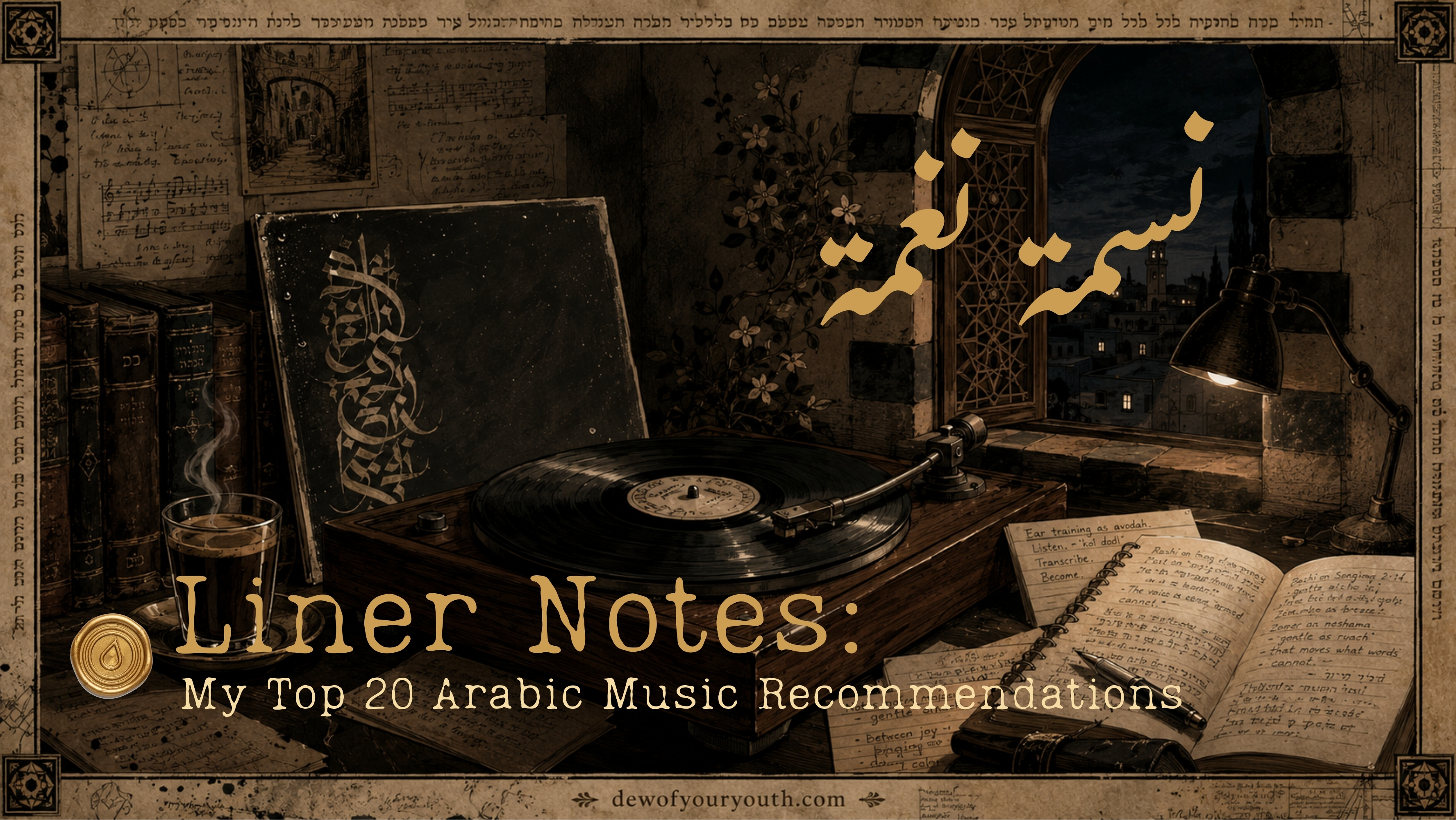
On my Arabic blog Daily Derja, I have been writing about Arabic music and language and ear training for a while now. I have a series of posts dedicated to it called “Melody Breeze نسمة نغمة”. Many of the Tunisian and Levantine songs on the list have either been featured in those posts or are planned future entries.
This post also happens to land right around Daily Derja’s first birthday — which feels fitting, since most of this list grew out of a year of writing about Arabic music there.
Melody Breeze
Short, recurring notes on Arabic songs — lyrics, dialect quirks, and ear training. As well as just Arabic posts on music I'm listening to.
If you’d rather just press play than read twenty mini-essays, I put every song from this list into one Spotify playlist.
A friend immediately pointed out that I left out obvious giants: Amr Diab, Asalah, Wael Kfoury, Nassif Zeytoun, George Wassouf, and others.
He is right.
This list is not meant to be a canon of Arabic music. It is a listening journal: songs I actually spent time with while learning Arabic. Some of the giants are missing because I have not yet lived with their music enough to write about it honestly.
Stay tuned for “Melody Breeze” posts on some of those artists in the future on Daily Derja.
1. Liya Snin
Liya Snin · Ÿuma
“It’s been years”
نحيت الحيرة والخوف وجرات ليام
حليت كتابي وقريت ولقيت حروف
حكاية مطروزة بالصوف تدفي الأيتام
والساعة ماني مكفوف تحلّو البيبان
ليّا سنين
I removed confusion and fear, and the days passed
I opened my book and read, and found letters
A tale embroidered with wool to warm the orphan
And now I am no longer blindfolded; the doors open
It’s been years
I could write this whole post about my favorite Ÿuma songs and it would be a worthwhile read. But the scope would be a little too narrow for me, so I decided to include Liya Snin as the main entry. I will include a few more Ÿuma songs under this heading without discussing each one.
About Ÿuma
Ÿuma are the kind of band that make Tunisian Arabic sound like it was always meant to be whispered into a microphone over a desert-colored guitar line. They are not trying to make “Arabic music” in the museum sense. They are not trying to prove that Tunisian dialect belongs in art. They simply sing in Tunisian because that is the language of the emotional world they are writing from.
That matters for a learner. A lot of Arabic learning pushes you toward formal Arabic, news Arabic, religious Arabic, or the clean pedagogical dialect of textbooks. Ÿuma give you something else: intimate Tunisian. Not classroom Tunisian. Not “repeat after me” Tunisian. Tunisian that breathes.
Liya Snin
Liya Snin has the feeling of someone emerging from a fog. The imagery is literary, almost mystical: fear removed, days passing, a book opened, letters found, a story embroidered with wool, doors opening. It does not feel like a pop song explaining itself to you. It feels like someone remembering themselves.
For ear training, this is one of the best kinds of songs. It is slow enough that you can begin to hear the phrase boundaries, but not so slow that it becomes artificial. The melody gives the words shape. The repetition of ليّا سنين lets the phrase sink in without turning it into a vocabulary drill.
Some of My Favorite Yuma songs:
- Smek (Especially the Rey&Kjavik Remix)
- Ghir Alik (There’s is also a rap song by 4BDOU called Het Nfess that samples Ghir Alik)
- Elli Fet
- Khallini Chwaya
2. Souty / صوتي
Souty · Emel
“My voice”
صوتي ما عندو حدود
صوتي مالوشي نهاية
صوتي يرسملي وجود
وألوان جديدة في سمايا
My voice has no limits
My voice has no end
My voice draws my existence
And new colors in my sky
Souty means “my voice.” The word صوت / ṣawt means “voice” or “sound,” and صوتي / ṣawtī means “my voice.” With Emel, that word is never neutral. Her voice is not only an instrument. It is identity, resistance, proof of existence, and sometimes the only thing left when everything else has been taken away.
Emel Mathlouthi is a Tunisian singer and songwriter whose music has long been associated with protest, dignity, and political awakening. Her song Kelmti Horra became one of the iconic songs of the Tunisian revolution, and her broader style mixes North African melodic material with modern electronic production and art-pop intensity.
Souty is not casual street Tunisian in the way a rap track or Ÿuma song might be. It is more literary, elevated, and anthem-like. The phrases are clear and powerful: صوتي ما عندو حدود — “my voice has no limits.” That is easy to understand, but it carries the whole Emel universe inside it: voice as freedom, voice as body, voice as defiance.
Placed after Ÿuma, this song moves the list from intimate Tunisian folk into voice as identity. The first song opens the book and finds letters. This one asks what it means to have a voice at all.
3. Ba77it / بحّيت
Ba77it · Ghoula
“I became hoarse”
Ba77it is Arabizi for بحّيت: “I became hoarse.” More idiomatically, it can feel like “I shouted until my voice was gone” or “I complained until I went hoarse.” In the fuller title بحّيت و شكيت, the phrase means: “I became hoarse and complained.”
Ghoula is Tunisian, and his music sits in that appealingly strange space where folk memory, street texture, electronic production, and low-budget weirdness all become part of the same sound. It is not glossy electronic Arabic pop. It feels handmade, sampled, smoky, slightly broken, and very Tunisian.
The word بحّيت is a nice example of why Arabizi can be useful even when it is ugly. The 7 represents ح, so Ba77it points you toward a doubled ḥ sound: baḥḥīt. You do not have to like Arabizi aesthetically to appreciate that it preserves distinctions English spelling would otherwise flatten.
After Souty, this entry feels like a dark joke: first, “my voice”; then, “I became hoarse.” One song treats the voice as liberation. The other treats it as something used up by complaint, pressure, and exhaustion. Together, they give two very different Tunisian answers to the question of what a voice is for.
4. La2a La2a / لأ لأ
La2a La2a · Young RZ
“No, no”
La2a La2a was the song I was trying to remember when I had “Little Razi” floating around in my head. The artist is Young RZ, a Tunisian rapper whose name makes the misremembering make sense in retrospect.
The title La2a La2a means “No, no.” In Arabizi, the 2 usually represents the Arabic hamza, so La2a is لأ / la’a rather than just a flat la. That little catch in the throat matters. It makes the refusal sharper, more colloquial, more spoken.
This belongs on the Tunisian hip-hop side of the list. Where Ÿuma give Tunisian Derja its intimate indie-folk face, and Ghoula gives it a smoky electronic weirdness, Young RZ gives you a more current street-pop/trap register: clipped delivery, confidence, repetition, and the kind of hook that is built to survive bad speakers and phone recordings.
For a learner, this is useful because it is not “pretty Arabic.” It is not arranged to help you. It is fast, stylized, and contemporary. But that is part of the point. If you want your ear to understand real Arabic music ecosystems, you need some rap and trap in the mix — not only folk, jazz, and poetic exile songs.
5. Mrara / مرارة
Mrara · Blingos
“Bitterness / bitterness of life”
Mrara means bitterness. In Arabic, مرارة / mrāra can refer literally to bitterness as a taste, but in songs it usually points to the bitterness of experience: disappointment, emotional damage, the sourness that life leaves in your mouth after enough things go wrong.
Blingos is a Tunisian hip-hop artist, and Mrara sits firmly in the contemporary Tunisian rap world. What makes the title useful is that it is not a complicated word, but it is emotionally dense. مرّ / murr means “bitter,” and مرارة / mrāra is the noun: bitterness. It is the kind of word that belongs naturally in rap because rap is so often about taking private grievance and making it rhythmic.
For a learner, this gives another side of Tunisian Derja. Ÿuma give you tenderness and folk intimacy. Ghoula gives you electronic strangeness. Young RZ gives you trap refusal. Blingos gives you the harder emotional vocabulary of Tunisian rap: hurt, pride, resentment, survival, and the need to sound unbothered even when the whole song is proof that you are bothered.
6. Dana Dana / دنا دنا
Dana Dana · Rima & Cheb Rayan
“Come closer / Draw near”
دنا دنا دنا دنا
دايني يا ما ما ما ما
كيتي ما جاني نوم
قلبي بيك مغروم
Come closer, come closer
You’ve carried me away, oh mother
Since you, sleep has not come to me
My heart is infatuated with you
Dana Dana is one of those songs that feels immediately familiar even before you understand the words. It has the polished, wedding-friendly, early-2000s Maghrebi pop sound: romantic, repetitive, danceable, and completely unembarrassed by its own sweetness.
The title دنا دنا comes from the Arabic root د ن و, meaning “to come near” or “draw close.” In the song it works less like a sentence and more like a hook: come closer, come closer, come closer. It is not complicated poetry. It is the musical equivalent of leaning across the room.
The language sits in a Maghrebi romantic-pop zone. You hear phrases like قلبي بيك مغروم — “my heart is infatuated with you” — which are broadly understandable across Arabic pop, alongside more regionally flavored phrasing and pronunciation. It is not Tunisian Derja exactly, and not Levantine, but it is very useful for getting your ear into North African Arabic music.
What I like about this kind of song is that it reminds you not all Arabic listening has to be profound. Some songs are there because they are sticky. The repetition is the point. دنا دنا burrows into your head, and once it is there, you have acquired a tiny emotional chunk of Arabic whether you intended to or not.
There is also something in Dana Dana that reminds me of Bollywood: not because it sounds Indian exactly, but because it has that same big-hearted, melodramatic sweetness. The song is romantic without being embarrassed about romance. The hook is repetitive, the feeling is direct, and the whole thing sounds like it could belong to a scene where longing, flirtation, and choreography all blur together.
That may be part of why it sticks so quickly. It is not austere music. It is not trying to be cool in the indie sense. It has the emotional generosity of popular cinema music: come closer, my heart is lost in you, I cannot sleep, the feeling is too big to keep private. In that sense, the Bollywood comparison is less about musical structure and more about emotional scale.
7. Sbart Ou Tal Adabi / صبرت وطال عذابي
Sbart Ou Tal Adabi · Mohamed Lamouri
“I endured, and my torment went on and on”
You will find that there are few things in this world more refreshingly carefree than listening to this blind, stoic, chain-smoking Algerian man sing about suffering while playing a cheap Casio keyboard. The “not trying too hard” swagger of Mohamed Lamouri, paired with his lo-fi sound, gives the song a strange dignity. It is sad, but it does not beg you to be impressed by its sadness.
The title صبرت وطال عذابي means “I endured, and my suffering dragged on.” The verb صبرت is one of those Arabic words that carries a whole moral universe: patience, endurance, bearing pain without collapse. But in a love song, patience can become pathetic. You waited. You endured. Your torment did not ennoble you. It simply lasted.
Lamouri’s version is connected to the repertoire of Cheb Hasni, the murdered Algerian raï singer whose work became a kind of emotional archive of wounded romantic masculinity. But Lamouri strips the sound down until it feels like someone singing at the edge of the metro platform, half performer, half ghost.
8. Ya Rayah / يا رايح
Ya Rayah · Rachid Taha
“O Departing One / O Traveler”
يا رايح وين تسافر تروح تعيي وتولّي
إيش حال ندموا العباد الغافلين قبلك وقبلي
O traveler, where are you going? You’ll tire yourself out and come back.
How many heedless souls have regretted it before you and before me?
Ya Rayah is one of those songs that sounds festive until you understand it, and then the floor drops out. The title is often translated as “O Traveler,” which works beautifully as a title, but the literal Arabic is closer to “O you who are leaving” or “O departing one.”
Rachid Taha’s version made the song internationally famous, but the song itself comes from Dahmane El Harrachi and the Algerian chaâbi tradition. It is a song about migration, exile, return, disillusionment, and the false glamour of leaving. The singer is not cheering the traveler on. He is warning him.
The line تروح تعيي وتولّي is devastating in its simplicity: you will go, you will get tired, and you will come back. The verb تعيي is especially Maghrebi: to become tired, worn out, exhausted. This is not the romance of travel. This is the exhaustion of exile.
9. Ila Mata / إلى متى؟
Ila Mata · Bab L’ Bluz
“Until when? / How long?”
أناس لم تعد لها قيمة
والاختلاف صار جريمة
والاختلاف صار جريمة
والاختلاف صار جريمة
People no longer have value
And difference has become a crime
Difference has become a crime
Difference has become a crime
Ila Mata means “until when?” or more idiomatically, “how long?” It is one of those Arabic titles that is already a protest slogan. You do not need a full sentence. إلى متى؟ is enough: how long will this continue, how long will people accept it, how long will everyone pretend not to see what is happening?
Bab L’ Bluz are a Moroccan-French band led by Yousra Mansour, and their sound pulls Moroccan and North African roots into psychedelic blues and rock. This is not “fusion” in the bland restaurant-playlist sense. It is North African music with electricity running through it.
The song’s lyrics were inspired by Tunisian poet Anis Shoshan and aim at racism, herd mentality, and the way difference becomes criminalized. The line والاختلاف صار جريمة — “and difference has become a crime” — gives the song its moral center. It is not subtle, but it does not need to be. Some songs exist to name the thing directly.
For a learner, this is interesting because the title is clean, almost classical Arabic — إلى متى؟ — while the band’s broader identity is Moroccan and Darija-rooted. That mixture is common in Arabic music: a phrase may be formal enough to travel across the Arabic-speaking world, while the voice, rhythm, and musical body remain deeply local.
What I like about Ila Mata is that it sounds like protest without sounding like a speech. The groove is heavy, the voice is fierce, and the question keeps hanging there: إلى متى؟ How long?
10. Dabkeh / دبكة
Dabkeh · Bedouin Burger
“Dabke, Levantine line dance”
Dabkeh is by Bedouin Burger, the project of Syrian vocalist Lynn Adib and Lebanese producer Zeid Hamdan. Their music sits right where I like this kind of Arabic fusion to sit: close enough to folk music that the roots are still audible, but electronically rearranged enough that it does not feel like a heritage exhibit.
The title دبكة / dabkeh refers to the Levantine line dance performed at weddings, parties, and public celebrations. It is one of the most recognizable communal dance forms in the Levant: people linked together, feet striking the ground, rhythm turning the group into one moving body.
That matters because the word is not just a genre label. Dabkeh carries a whole social world with it. It suggests weddings, village squares, resistance songs, family parties, nationalism, joy, masculinity, flirtation, and the stubborn refusal to let the body become private. In much of the Levant, dabkeh is not just “dance music.” It is a way of saying: we are here, together, with our feet on this ground.
Bedouin Burger’s version does not sound like a standard wedding dabkeh track. It feels more like the idea of dabkeh refracted through an indie-electronic imagination: folk pulse, voice, beat, repetition, and modern production. Zeid Hamdan gives it the machine; Lynn Adib gives it the human breath.
For a learner, this kind of song is useful because Arabic is not only vocabulary and grammar. It is also movement. Some words are attached to social forms. You do not really understand دبكة by translating it as “dance.” You understand it by hearing the stomp inside the word.
A quick aside
Enjoying this post?
Come along on WhatsApp or Telegram — new posts, reflections, and the occasional spiral.
11. WBa3dein? / وبعدين؟
WBa3dein? · Kazdoura
“And then?”
بعمل إشيا ما إلها لزوم
لآخد مكاني وحقّي يدوم
قبل ما يبلعني هالكون
وبلّش عصب وجنّ ولوم
وبعدين؟
I do things that have no point
To take my place and make my due last
Before this universe swallows me
And I start getting angry, going mad, and blaming
And then?
Kazdoura means “stroll” in Levantine Arabic, and the name fits. Their music wanders. It does not walk in a straight genre line. The duo consists of Syrian vocalist Leen Hamo and Lebanese multi-instrumentalist John Abou Chacra, and their sound bridges modern Arabic music with psychedelic funk, soul, and atmospheric electronic production.
WBa3dein? is the kind of song that sounds smoother than its subject matter. The groove is laid back, but the lyrics are restless. The speaker is trying to claim space before being swallowed by the universe, then gets caught in the loop of anger, madness, blame, and the question: وبعدين؟ And then?
That phrase is one of the great everyday Arabic phrases. وبعدين؟ can mean “and then?” in a neutral storytelling sense, but it can also mean “so what now?”, “where does this leave us?”, or “how long is this going to go on?” It is a question with impatience inside it.
The song feels like social exhaustion: judgment, pressure, self-assertion, defiance, and the final decision not to care as much as everyone wants you to care.
12. Lala / لا لا
Lala · Shkoon
“No, no / Lala”
Lala is not a title I would over-translate. It can be heard as لا لا — “no, no” — but in the song it functions more like a sung refrain, a vocative, a folk syllable, a little melodic hook the song gathers around.
Shkoon are very good at making Arabic folk fragments feel suspended in electronic space. Their music often sounds like someone took an old courtyard song, opened it up, and let the night air and synthesizers into it. Lala has that quality. It is electronic, but not cold. Folkloric, but not archival.
The dialect here is Levantine, with a Syrian flavor. Phrases like ليش الزعل and زعلت لحالها sit very comfortably in the Levantine world. For a learner, it is a good bridge song: recognizable colloquial phrases, repeated enough to stick, but carried by a sound that does not feel like a textbook dialogue.
13. Saida / سعيدة
Saida · Walaa Sbait
“Happy / Happiness”
Saida means “happy” if read as سعيدة, though it can also be a woman’s name. The sound of the song is bright, danceable, and mischievous. It has that ska bounce that makes melancholy feel like it has been forced to put on good shoes and move.
Walaa Sbait is Palestinian, and his music often carries that mixture of local rootedness, theatricality, politics, and humor that makes Palestinian art difficult to reduce to slogans. Saida is not “language learning content.” It is a song. But for a learner, it is useful precisely because it is alive. You hear Levantine Arabic in rhythm, in crowd energy, in repetition, in performance.
There is also something important about hearing Arabic in joyful registers. A lot of outsiders encounter Arabic through news, conflict, religion, politics, or threat. Songs like this remind your ear that Arabic is also party music, teasing music, street music, wedding-adjacent music, music for being ridiculous with other human beings.
14. Ruh Bladi / روح بلادي
Ruh Bladi · TootArd
“The soul/spirit of my homeland”
جبل وصحرا وبحر وغابة
طبيعة روح بلادي
شجرة خضرا بنص الوادي
هيدي روح بلادي
Mountain and desert, sea and forest
Nature is the spirit of my homeland
A green tree in the middle of the valley
This is the spirit of my homeland
TootArd are from Majdal Shams in the Golan Heights, and that matters for how their music feels. Their name means “strawberry” in Arabic, but their songs are not sweet in a simple way. They often sound like music made by people living between borders, identities, and landscapes.
Ruh Bladi means “the soul of my homeland” or “the spirit of my country.” The word روح / rūḥ can mean “soul,” “spirit,” or even “breath,” depending on context. بلادي / blādi means “my land,” “my country,” or “my homeland.” So the title is not just patriotic in a flag-waving way. It is more elemental than that: land as mountain, desert, sea, forest, valley, tree.
The idea of Ruh Bladi is that the soul of the homeland is nature, freedom, and a lost simpler life. It is not just saying “I love my country” in a patriotic way. It is saying: my homeland is mountain, desert, sea, forest, green trees, clean water, wind, coffee, Bedouin life, and the possibility of moving freely.
The song has a relaxed reggae-rock pulse, but the emotional center is rooted and local. It is not a national anthem. It is not a protest slogan. It feels more like someone naming the physical world around them in order to say: this is where I come from, this is what formed me, this is what still lives in me.
For a learner, the language is accessible in a useful way. Words like جبل “mountain,” صحرا “desert,” بحر “sea,” غابة “forest,” شجرة “tree,” and وادي “valley” are concrete, image-heavy vocabulary. That makes the song unusually easy to attach to memory. You are not just learning abstractions. You are hearing a landscape.
15. Ghareeb Alay / غريب عليّ
Ghareeb Alay · Elyanna & Balti
“Strange to me / You feel like a stranger to me”
أنا هون إنت وين
يا حبيبي غريب عليّ
غريب عليّ
غريب عليّ
I am here, where are you?
My love, you feel strange to me
Strange to me
Strange to me
Ghareeb Alay is a duet between Elyanna, a Palestinian-Chilean singer, and Balti, one of Tunisia’s biggest rappers. That pairing alone makes the song useful for Arabic listening: you get Palestinian Levantine Arabic and Tunisian Derja in the same emotional space.
The title غريب عليّ literally means “strange to me,” but in a romantic context it lands more like: “you feel like a stranger to me now.” It is not the strangeness of someone exotic. It is the worse kind of strangeness: someone once close has become emotionally unfamiliar.
Elyanna’s part is smooth, airy, and Levantine. She sings:
أنا هون إنت وين
I am here — where are you?
That is about as simple as Arabic gets, but in the song it becomes a whole emotional situation. I am here. You are somewhere else. We are not occupying the same emotional place anymore.
For a learner, this song is especially good because the chorus is easy to catch, while Balti’s verse gives you a taste of Tunisian pronunciation and vocabulary without throwing you into the deep end of fully dense Derja. It is also a reminder that contemporary Arabic pop is increasingly transnational. A song can move between Palestine, Tunisia, Chile, Los Angeles, reggae-pop production, and rap, and still feel emotionally coherent.
16. Ya Watan / يا وطن
Ya Watan · Alsarah & the Nubatones
“O homeland”
Ya Watan means “O homeland.” The word وطن / waṭan is one of those Arabic words that carries more weight than its English equivalent. It can mean homeland, nation, country, native land, the place you belong to, or the place that continues to claim you even after you leave.
Alsarah & the Nubatones describe their sound as East African retro-pop, and that phrase fits better than the vague “world music” label. Alsarah is a Sudanese-American singer, songwriter, and ethnomusicologist; her band’s sound draws on Nubian and East African musical memory while living comfortably in a modern diasporic setting.
What makes the song work is that it is not a simple patriotic anthem. It is about homeland as longing, necessity, survival, and movement. That is a very different emotional relationship to homeland than the one in Ruh Bladi. Ruh Bladi feels like land as landscape: mountain, desert, sea, forest, clean water. Ya Watan feels more like homeland as ache. The homeland is not only a place you stand in. It is the thing you carry after displacement, the thing you address because you cannot quite possess it.
For a learner, this is also a useful reminder that Arabic does not only move east-west between the Levant and the Maghreb. There is also Sudanese Arabic, Nubian musical memory, East African rhythm, diaspora Arabic, and the sound of Arabic shaped by the Nile from another direction.
17. Kifak Enta / كيفك إنت
Kifak Enta · Fairuz
“How are you?”
كيفك إنت
إن شاء الله تكون بخير
مش إنت قلت بآخر مرة
إنك مش راح تغيب كتير
How are you?
I hope you are well
Didn’t you say last time
That you wouldn’t be gone long?
Kifak Enta means “How are you?” in Lebanese Arabic. The phrase is simple — كيفك إنت؟ — but the song is not simple at all. It is one of those Fairuz songs where an ordinary expression becomes emotionally dangerous. “How are you?” is not really small talk here. It is a door opening onto memory.
Fairuz is unavoidable in Arabic music. You do not have to listen to her every morning, and you do not have to turn your Arabic taste into a museum of respectable classics, but at some point the road passes through Fairuz. Her voice is one of the central sounds of modern Lebanese and Arab musical memory.
What makes Kifak Enta useful for a learner is that the title itself is immediately usable. كيفك؟ is one of the first things people learn in Levantine Arabic. But the song shows you how a basic phrase can carry adult emotional weight. In a textbook, kifak enta means “how are you?” In Fairuz, it means: I remember you, I am asking more than I can say, and this question is not innocent.
The song also gives the list a clean Fairuz entry without making the whole post about Fairuz. It sits nicely beside Al Bint El Chalabeya: one is a folk-like classic sung through Dorsaf Hamdani’s Tunisian voice, and the other is Fairuz herself, turning a plain Lebanese phrase into an ache.
18. Bisaraha / وبصراحة
Bisaraha · Ziad Rahbani
“Honestly / Frankly”
وبصراحة بما إنو بصراحة
و بما إنو مافي أحلى من الصراحة
بصراحة .. ما عدت إعنيلك شي
Honestly, since it’s honesty
And because there is nothing sweeter than honesty
Honestly... I no longer mean anything to you.
This song is about being betrayed by the woman you loved most. It is tied to the true-life story of Ziad Rahbani and his very public divorce from Dalal Karam. The song is a swingy, theatrical jazz number that drips with the facetious kind of sarcasm that accompanies betrayal and divorce.
Ziad Rahbani is one of the great figures of modern Lebanese music: composer, pianist, playwright, satirist, son of Fairuz and Assi Rahbani, and a man who made Lebanese colloquial Arabic feel devastatingly sharp on stage and in song. He had a gift for making ordinary speech sound composed without losing the sting of ordinary speech.
The genius of Bisaraha is that the word “honestly” becomes less honest every time he says it. بصراحة is supposed to introduce truth. Here it introduces a performance of truth, the kind of “frankness” people use when they are too hurt to speak plainly. It is funny, wounded, elegant, and mean.
For learners of Levantine Arabic, this is useful because it is not only vocabulary. It is tone. You hear how Lebanese Arabic can bend irony into melody.
19. Habibi Lawel / حبيبي الأول
Habibi Lawel · Habiba Msika
“My first love”
Habibi Lawel means “my first love.” The title is probably حبيبي الأول / ḥabībi l-awwel: حبيبي means “my beloved,” and الأول means “the first.” In North African pronunciation and transcription, that can easily become lawel.
Habiba Msika — also spelled Habiba Messika — was one of the great figures of early modern Tunisian music and theater. Born Marguerite Msika into the Jewish community of Tunis, she became a massive star in the 1920s: singer, actress, celebrity, scandal, object of fascination, and symbol of a changing urban culture.
This is the Jewish-Arab world that often disappears from simplified modern narratives. Msika was Jewish and Tunisian. She sang in Arabic. She belonged to the theatrical and musical culture of Tunis. Her world was not divided neatly into the categories people now like to impose retroactively. Arabic music was also Jewish music, because Jews were part of Arabic-speaking societies and helped create their sound.
That is why I wanted Habiba Msika on this list. Not as a token Jewish entry, but because she represents something real: a Tunisian Jewish diva whose voice belonged to the Arab musical world of her time.
Her life also had one of the most tragic endings in North African music history. In 1930, an obsessive admirer entered her apartment in Tunis and set her on fire. She died the next day, still in her twenties. Her murder shocked her public, but it also deepened her legend. The story is lurid, but it should not swallow the artist. Msika was not important because she died violently. She was important because she lived loudly before that violence tried to silence her.
For a learner, Habibi Lawel is not the easiest kind of Arabic listening. The recording tradition is older, the diction is not the same as modern Tunisian rap or indie music, and the sound world is closer to early 20th-century Arab theater and song. But that is exactly why it belongs here. Arabic is not only contemporary dialect practice. It is archives, ghosts, vanished communities, old shellac records, and voices that somehow survived the century.
20. Lampedusa
Lampedusa · Labess
“Lampedusa, the Italian island”
Lampedusa is named for the Italian island between Tunisia, Malta, and Sicily — a place that has become one of the symbols of Mediterranean migration. For many North Africans, Lampedusa is not just a dot on a map. It is the imagined doorway to Europe, the island on the other side of the sea, the place people risk their lives trying to reach.
Labess are the right band for this kind of song because their music already sounds like movement between worlds. Algerian chaâbi, Gnawa, flamenco, rumba, folk, and Mediterranean street-song energy all pass through their sound. Their music feels like it belongs to ports, borders, borrowed apartments, late-night cafés, and people who have learned to carry home as something portable.
Placed at the end of this list, Lampedusa changes the shape of the whole post. The earlier songs move through love, bitterness, refusal, homeland, exile, dance, memory, and voice. Lampedusa brings all of that to the sea. It is the Mediterranean not as vacation fantasy, but as crossing, risk, hope, desperation, and graveyard.
That makes it a fitting final song. Arabic music in this list has moved across Tunis, Algeria, Morocco, Palestine, Lebanon, Syria, Sudan, and the Jewish-Arab archive. Lampedusa closes with the water between those worlds and Europe — the water people sing across, flee across, drown in, and dream beyond.
For a learner, the song is also a reminder that language is never just vocabulary. A place name can carry a whole history. Lampedusa is not an Arabic word, but in a Maghrebi song it becomes part of the Arabic emotional map: migration, hunger, dignity, danger, and the terrible courage of leaving.
Final Notes on Dialect
One of the first shocks of listening to Arabic music seriously is realizing that “Arabic” is not one listening skill. Tunisian Derja, Algerian Derja, Moroccan Darija, Lebanese Arabic, Palestinian Arabic, Syrian Arabic, Sudanese Arabic, Egyptian Arabic, Yemeni Arabic, and literary Arabic are all connected, but they are not interchangeable.
That can be frustrating if you want a clean learning path. But it is also the pleasure of the thing. Every dialect gives you a different emotional instrument.
Tunisian can be clipped, intimate, French-splashed, and unexpectedly tender. Lebanese can be theatrical, ironic, and musically elastic. Palestinian songs often carry land, exile, joy, and defiance in the same breath. Algerian music gives you exile, swagger, heartbreak, and rhythmic force. Moroccan music brings trance, blues, protest, and desert electricity. Sudanese and Nubian music remind you that Arabic also moves down the Nile and across East Africa. Literary Arabic gives you height and public seriousness.
So no, listening to music will not make you fluent by itself.
But it will give your ear somewhere to live.